HomeBenefit Programs

Flexible Spending Account (FSA)

Set aside tax-free money for health expenses

Overview & Eligibility

Employees who enroll in a flexible spending account (FSA) can experience tax savings on eligible expenses such as copays, deductibles, prescriptions, over-the-counter medicine, and thousands of other health items. Generally speaking, a health FSA should be offered only to employees who are also eligible to participate in the employer's major medical plan. Employers with a major medical or group health plan can offer an FSA to their employees.  It’s also important to note that, unlike health savings accounts, employers are not required to offer a high deductible health plan (HDHP) in order to offer an FSA. For an in-depth look at FSAs, check out our Ultimate FSA Guide

2026

Contribution Limit: $3,400

This is the maximum amount that can be contributed to an FSA each year per the IRS.

Carryover: $680

The Value for Employees

Save on Eligible Expenses

Employees can save up to 40% on thousands of eligible everyday expenses such as prescriptions, doctor’s visits, dental services, glasses, over-the-counter medicines, and copays.

Keep More Money
Keep More Money

Every dollar an employee contributes to an FSA lowers their taxable income. Let’s say an employee earns $40,000 a year and contributes $1,500 to an FSA. That means only $38,500 of their income gets taxed.

Easy Spending and Account Management

Employees will receive an Ameriflex Debit Mastercard® linked to their FSA. Employees can use their card for eligible purchases everywhere Mastercard® is accepted. Account information can be securely accessed 24/7 online and through the mobile app.

The Value for Employers

Cost Savings
Cost Savings

Since contributions to FSAs are taken out pre-tax, no payroll taxes are due on the amounts employees contribute to the FSA.

Employee Engagement
Employee Engagement

Nearly one-fourth of U.S. adults say they have problems paying medical bills. Helping employees save money on their everyday medical expenses can aid in employee retention and recruitment.

Expert Support
Expert Support

Healthcare is complicated. The Ameriflex Client Relationship Team is eager to answer questions and provide assistance. Our Net Promoter Score (NPS) far exceeds the healthcare average.
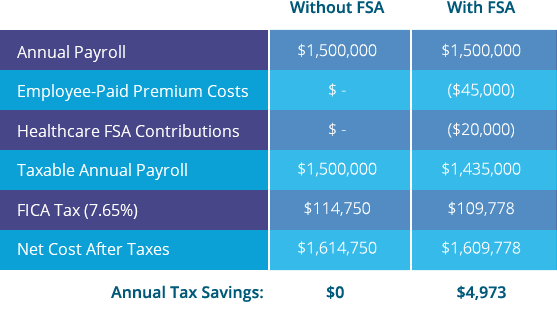
without fsa vs with fsa comparison chart

This scenario assumes the following:

  • Number of Eligible Employees: 50
  • Average Salary Per Employee: $50,000/year
  • Average Premium Paid Per Employee: $900/year
  • Average FSA Contribution: $2,000/year
  • Percent Expected to Enroll in FSA: 20%

FSA Guarantee

If employees spend more than they contribute, resulting in a net aggregate loss in the employer’s plan, Ameriflex will refund the difference back to the employer.


Card Swipe Guarantee®

One-of-a-kind in the industry, the Card Swipe Guarantee® is a feature offered to all FSA and HRA customers where we will take on the compliance liability around documentation. Our advanced technology allows us to ensure that participants’ FSA and HRA-eligible card transactions will go through without requiring them to submit further documentation.

MyPlanConnect

MyPlanConnect connects an employee’s FSA transactions with their insurance Explanation of Benefits (EOB). If the card transaction matches the employee’s EOB, MyPlanConnect will prepare the claim and allow the employee to request reimbursement without the need to submit additional documentation.

Flexible Savings Accounts FAQ

What do employers need to offer an FSA to their employees?

Any employer that offers a group health plan can add an FSA. Unlike an HSA, there is no requirement to offer a high deductible plan, which makes FSAs one of the easiest pre-tax benefits to implement. Ameriflex manages the setup and administration, so your HR team is not responsible for day-to-day management.

FSA contributions are made on a pre-tax basis, which means employers do not pay FICA payroll taxes on those amounts. As employees set aside money through payroll deductions, the employer’s taxable payroll is reduced, resulting in direct tax savings. Even with moderate participation, these savings can add up over the course of a plan year, making an FSA one of the few benefits that both supports employees and lowers employer costs.

A common concern with FSAs is that employees can spend their full election at the start of the year. With the Ameriflex FSA Guarantee, if the plan ends the year with an overall loss, Ameriflex reimburses the employer for the difference. This removes the financial risk that typically worries employers.

Healthcare costs remain a top financial stress for employees. Offering an FSA shows that your organization is invested in helping employees manage those expenses with tax-free dollars. In competitive hiring markets, that added support can help you stand out and keep employees longer.

FSAs are employer-sponsored and can be offered with most group health plans. HSAs are employee-owned and require a high deductible health plan. Employers who want broader eligibility and simpler implementation often start with an FSA, while some offer both by pairing an HSA with a Limited Purpose FSA.

With a third-party administrator like Ameriflex, very little. Ameriflex handles claims processing, compliance, and employee support, so HR is not fielding daily questions or managing documentation. Employees can also access their accounts anytime through the Ameriflex portal and mobile app.

Looking for information about your benefits?

Check out our Help Center
Help Center